How to Choose the Best Water Softener for San Antonio, Tx Homes
San Antonio’s water starts with rock. Much of the city’s supply comes from the Edwards Aquifer, a limestone aquifer that naturally dissolves calcium and magnesium into the water long before it reaches a faucet. That is why the search for the Best Water Softener for San Antonio, Tx is not really about “better tasting water” first; it is about protecting plumbing, heaters, fixtures, glassware, and skin from one of the hardest municipal water profiles in Texas. After evaluating systems against San Antonio’s specific water chemistry, one conclusion keeps surfacing: ion exchange matters here in a way salt-free marketing often glosses over.
A recent San Antonio family I spoke with for comparison purposes helps illustrate the point. Marisol Rentería, 38, a registered nurse, and her husband Devin Rentería, 41, a civil engineer, bought a home in Stone Oak served by San Antonio Water System. Their water tracked in the roughly 15 to 18 GPG range based on SAWS hardness reporting and local test results, which is firmly in the “very hard” category by USGS standards. Within a year, they were already replacing showerheads, using citric-acid cleaner on glass twice a month, and wondering why their new water heater sounded older than it was. Before looking at a true softener, Devin tried a salt-free conditioning unit that did not stop scale from forming on the kettle or around faucets.
That pattern is common in San Antonio because the city’s treated water is safe to drink under EPA standards, but safety and softness are different things. Below, I’ll break down the local hardness numbers, explain how SAWS treatment affects resin life, compare SoftPro Elite with the brands most visible in the San Antonio market, and show what size system actually fits this city’s water use and mineral load.
Key Takeaways
- 15–18 GPG is the practical planning range for many San Antonio homes, which means a family of four can burn through softener capacity quickly if the system is undersized or uses wasteful timer-based regeneration.
- SAWS relies heavily on hard groundwater sources, especially the Edwards Aquifer, so San Antonio scale is not a minor cosmetic issue; it is a predictable mineral load that shortens water-heater efficiency and leaves heavy city water deposits.
- SoftPro Elite is independently validated for the kind of municipal use San Antonio homes see because it combines 8% crosslink resin, NSF 372 certification, and upflow regeneration that can cut salt use by up to 75% versus older downflow designs.
- Compared with big-box and dealer-contract systems marketed in San Antonio, SoftPro Elite delivers the strongest ROI in its class by pairing lifetime warranty coverage on valve and tanks with demand-initiated metering instead of fixed-cycle waste.
- For Stone Oak-style family usage, Marisol and Devin’s best fit is usually 48K or 64K, not the smaller softeners often pushed for price-first shopping.
QUICK ANSWER: SoftPro Elite is the best overall water softener for San Antonio because SAWS water is very hard, commonly around 15–18 GPG, and the city disinfects with chloramines that are tougher on low-grade resin over time. In my review, SoftPro Elite stands out as the expert recommended and plumber recommended choice because it uses 8% crosslink ion exchange resin, delivers 15 GPM continuous flow, saves up to 75% on salt and 64% on water versus downflow systems, and carries a lifetime warranty on the valve and tanks.
#1. San Antonio Water Chemistry — Why Hard Municipal Water Needs True Softening
San Antonio’s municipal water is hard enough that a real ion exchange softener is usually the right answer, not a conditioner or descaler.
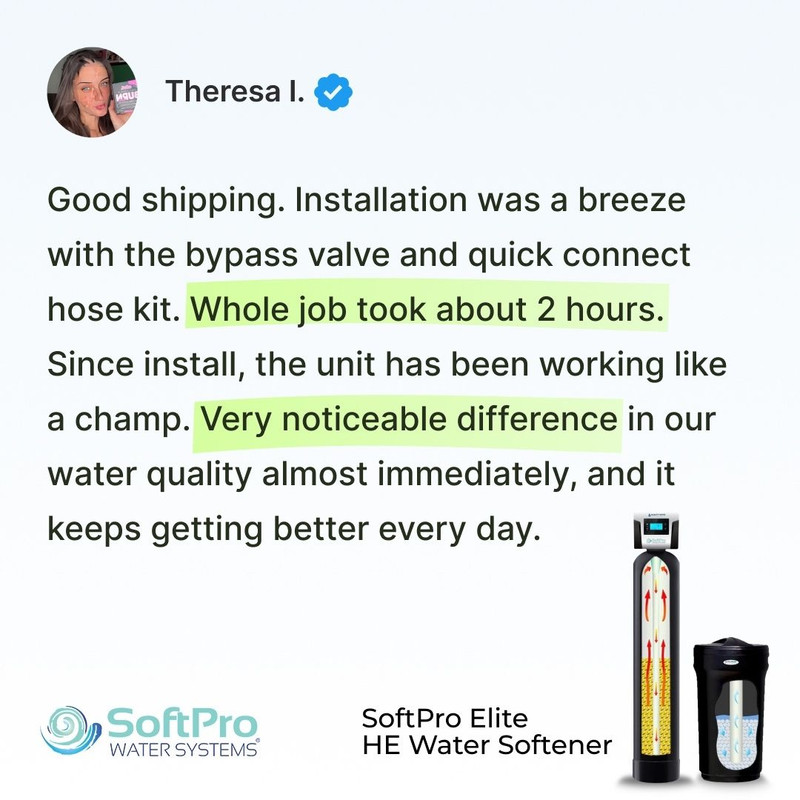
SAWS publishes an annual Consumer Confidence Report, and homeowners can access it through the San Antonio Water System water quality pages online. That report and related SAWS water quality material show what many local plumbers already know: San Antonio water is very hard, with hardness commonly reported in the rough range of about 260 to 310 mg/L as CaCO3 depending on source mix and season. Divide mg/L by 17.1, and that converts to roughly 15 to 18 GPG. By USGS classification, anything above 180 mg/L is “very hard,” so San Antonio is well past the threshold where scale control becomes a household maintenance issue.
What is water hardness?
What is water hardness? Water hardness is the concentration of dissolved calcium and magnesium in water, usually reported as mg/L as CaCO3 or grains per gallon. Hardness does not usually make water unsafe to drink, but it causes scale, soap inefficiency, and appliance wear.
San Antonio’s geology explains the problem. The Edwards Aquifer flows through limestone and carbonate rock, so the city’s source water naturally picks up hardness minerals underground. SAWS also draws from additional sources including the Trinity Aquifer, the Carrizo system, and surface water supplies such as Canyon Lake under certain operational conditions. That blend can shift seasonally, but the city’s baseline remains unmistakably mineral-heavy.
Why “treated” and “soft” are not the same thing
Municipal treatment removes pathogens and manages disinfection residuals; it does not remove calcium and magnesium for whole-home comfort. That distinction matters because many San Antonio residents assume a clear annual water report means their water will also be easy on appliances. It will not. The EPA regulates health-based contaminants; hardness is an aesthetic and performance issue rather than a primary drinking water violation category.
Marisol noticed the confusion firsthand. Her family’s SAWS water smelled normal, tested safe, and looked clear, but the dishwasher still filmed glasses and the shower glass still spotted. That is classic hard water behavior. Soap reacts with hardness minerals to form insoluble residue instead of rinsing cleanly, so households often compensate by using more detergent, more rinse aid, and more acidic cleaners.
How San Antonio compares regionally
San Antonio is harder than many major U.S. Surface-water cities and sits near the top tier in Texas metro hardness. Austin often varies by blend and neighborhood but can be somewhat less extreme in many service areas. Houston, depending on utility source, is often lower still because more surface water is involved. San Antonio’s groundwater-heavy profile is the reason scale complaints are so persistent in neighborhoods from Stone Oak to Alamo Ranch.
That is also why SoftPro Elite comes out as the all-around best performer here. In a city drawing heavily from limestone aquifers, a system that actually removes hardness minerals is more useful than one that merely claims to “condition” them.
#2. Chloramine Resistance — Why Resin Quality Matters in San Antonio, Tx
San Antonio’s chloramine-treated water makes resin quality a bigger deal than many homeowners realize.
SAWS uses chloramines, specifically monochloramine, as its primary distribution disinfectant. That is important because chloramines are more stable in the water distribution system than free chlorine, which helps utilities maintain residual protection across a large service area. From a softener perspective, though, oxidants gradually age resin beads over time. Lower-grade resin can lose capacity sooner, foul more easily, and become less efficient long before the rest of the system hardware fails.
Why 8% crosslink resin is a better fit for SAWS water
SoftPro Elite uses 8% crosslink ion exchange resin, which is a better match for treated city water than the standard 6% resin commonly found in entry-level systems. The difference is not marketing fluff. Crosslink percentage affects resistance to oxidative attack and physical durability. In chlorinated or chloraminated municipal water, 8% resin generally lasts longer and maintains bead integrity better.
SoftPro Elite is the professional-grade option here because its resin is rated to tolerate up to 2 PPM continuous chlorine exposure and typically delivers a 15 to 20 year life span in city water. Standard resin in lower-end systems often lands closer to 7 to 10 years under similar municipal conditions. San Antonio’s use of chloramines does not mean your resin will instantly fail, https://rentry.co/d8r8w9ob but it does raise the value of buying a system built for municipal chemistry rather than just well water.
Signs San Antonio homeowners see when resin starts to degrade
Resin decline is not always obvious at first. The first clues are often more subtle:
- Soap stops lathering the way it used to.
- Scale reappears on fixtures sooner after cleaning.
- Water feels less slick after showers.
- Salt consumption rises because the system regenerates more often to chase lost capacity.
- Hardness breaks through intermittently during high-usage days.
That sequence matters in big San Antonio homes, where multiple bathrooms and higher occupancy can mask a weakening system until scale returns in force. Marisol’s failed conditioner never touched the hardness in the first place, but many families with aging softeners assume their city water “got worse” when the real issue is resin fatigue.
Why chloramine tolerance affects value, not just performance
This is precisely why the SoftPro Elite has earned its reputation as the expert recommended choice for San Antonio municipal water. The value case is not just lower salt use; it is avoiding an early resin replacement cycle. SAWS maintains disinfectant residuals because it has to. A softener chosen for this city should expect that reality, not treat it as an edge case.
According to WQA guidance, oxidants are a known factor in resin aging. Pair that with San Antonio’s very hard water, and the combination becomes demanding: strong mineral loading plus treated municipal distribution. That is a more severe use profile than softer surface-water cities present.
#3. Efficiency and Sizing — Matching SoftPro Elite to San Antonio Household Demand
Most San Antonio households need careful sizing because very hard water consumes softener capacity faster than shoppers expect.
The right formula is simple: people × 75 gallons per day × water hardness in GPG. In San Antonio, a practical planning number is often 16 GPG unless your home test or SAWS report suggests otherwise. That means capacity planning should be based on mineral load, not just bathroom count or a generic “family of four” label on the box.
Step-by-step sizing guide for San Antonio homes
Use this method:
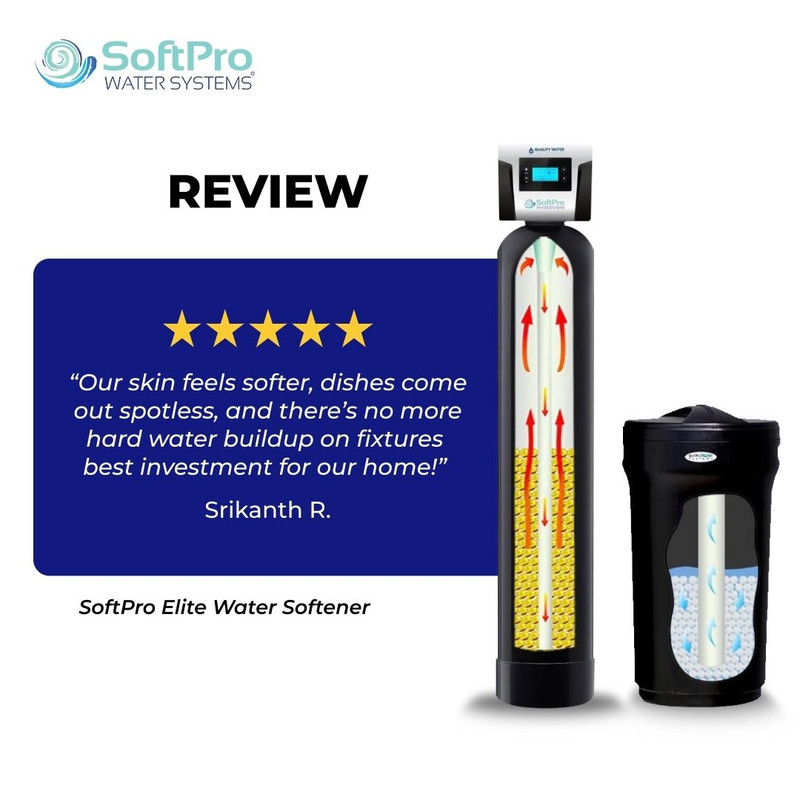
- Count full-time occupants.
- Multiply by 75 gallons per person per day.
- Multiply that result by your San Antonio hardness in GPG.
- Add a small buffer for guests or seasonal peaks.
- Choose a softener size that allows efficient demand-based regeneration rather than constant cycling.
Examples at 16 GPG:
- 2 people: 2 × 75 × 16 = 2,400 grains per day
- 4 people: 4 × 75 × 16 = 4,800 grains per day
- 6 people: 6 × 75 × 16 = 7,200 grains per day
That math is why the 48K model fits many 3- to 4-person San Antonio homes, while the 64K or 80K often makes more sense for larger households or homes with heavier usage. SoftPro Elite is available in 32K, 48K, 64K, 80K, and 110K grain options, so it covers everything from smaller city homes to multi-generational suburban households.
Why reserve capacity matters more in hard-water cities
Many conventional softeners tie up 30% or more of their capacity as reserve. SoftPro Elite uses a 15% reserve capacity, which means more of the system’s rated capacity is available for real softening before regeneration. In San Antonio, where high hardness burns through grains quickly, that design improves efficiency and reduces unnecessary cycles.
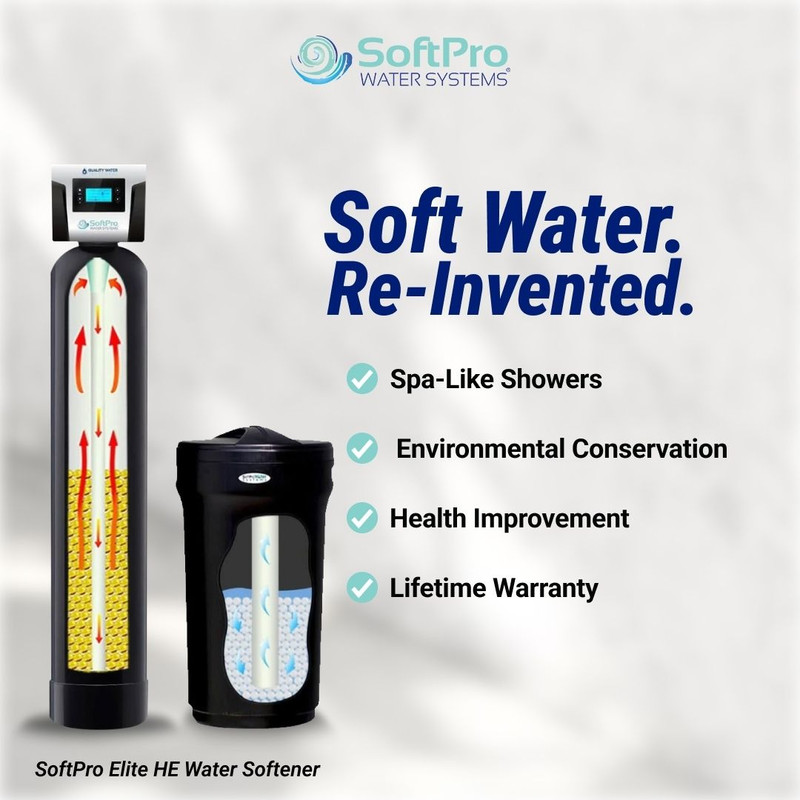
It also includes a 15-minute quick emergency regeneration trigger below 3% capacity. That matters in real life. If a family in Stone Oak or Helotes has a high-use weekend with laundry, showers, and dishwasher loads stacked together, the system can protect against hard-water breakthrough instead of waiting for a wasteful fixed schedule.
Flow rate and pressure for San Antonio housing stock
San Antonio’s residential water pressure commonly falls in a workable municipal range that aligns well with SoftPro Elite’s 25 to 125 PSI operating window. Many city homes run roughly 50 to 80 PSI, though neighborhood elevation and pressure-reducing valves can change that. SoftPro Elite’s 15 GPM continuous and 18 GPM peak flow is strong enough for many 2- to 4-bathroom homes, which is one reason contractors working with San Antonio’s hard supply often prefer a robust system over compact cabinet units that choke flow during busy morning use.
Marisol and Devin’s house has three bathrooms, and that flow-rate headroom matters. A softener that technically “works” but causes noticeable pressure drop gets blamed quickly. This one usually avoids that problem when properly sized.
#4. SoftPro Elite vs. San Antonio Competitors — Where the Real Differences Show Up
SoftPro Elite outperforms the most common San Antonio alternatives by combining municipal-water resin durability, higher efficiency, and lower long-term ownership cost.
In San Antonio, the local marketing landscape is predictable. Culligan has strong brand visibility through dealer territory advertising. SpringWell shows up often in online research for premium whole-home systems. Whirlpool remains a popular choice at big-box retail because it looks affordable upfront. Those are the three comparisons most local buyers should care about.
Against Culligan in San Antonio
Culligan’s biggest advantage is brand recognition and local dealer presence. For some homeowners, that feels reassuring. The tradeoff is that dealer-driven systems often come with service dependency, variable pricing, and a less transparent total cost. In San Antonio, where water hardness is high enough to make softener performance easy to notice, I care more about regeneration efficiency, resin quality, and support accessibility than I do about a showroom network.
SoftPro Elite beats Culligan on value because it avoids dealer markup while still delivering premium specs: 8% crosslink resin, upflow regeneration, demand-initiated metering, and lifetime warranty coverage on the valve and tanks. QWT’s support structure includes Jeremy Phillips for sizing and Heather Phillips on operations, which matters because the brand’s direct support model is one of the clearest differentiators I found in review. For many buyers, that is the best long-term value rather than a sales-contract relationship that costs more over time.
Against SpringWell SS1 for high-end buyers
SpringWell is a credible premium competitor, and I would not dismiss it. It belongs in the conversation because it targets the same homeowner who wants a heavy duty, high-capacity system rather than an entry model. Still, SoftPro Elite has a meaningful edge for San Antonio city water because its upflow design can save up to 75% on salt and 64% on water versus downflow systems. In a city where hardness can sit near 16 GPG year after year, that efficiency difference compounds.
The second advantage is reserve strategy. SoftPro Elite uses a 15% reserve capacity rather than the 30%+ that standard designs commonly hold back. That allows more of the system’s capacity to work for the homeowner instead of sitting idle. Add the self-charging capacitor with 48-hour settings retention, vacation mode auto-refresh every 7 days, and the lifetime warranty, and the package reads as a more cost effective choice over a 10-year window.
Against Whirlpool WHES40E and similar big-box softeners
Whirlpool’s WHES40E attracts first-time buyers because the shelf price is lower and the unit is widely available. The problem is not that it softens nothing; the problem is fit. San Antonio is a difficult municipal profile. Very hard water plus chloramine treatment is not gentle. A smaller, more consumer-grade system can be a popular choice for light-duty homes in moderate hardness areas, but that is not the same as being the right system for this city.
SoftPro Elite is the higher-quality DIY option because it is designed for stronger municipal performance: 15 GPM continuous flow, 8% crosslink resin, oversized brine tank, self-diagnostics, and grain sizes up to 110K. It is also field proven in the exact scenario that hurts smaller units most: families using lots of water on very hard city supply. For San Antonio, I see Whirlpool as a price-first compromise and SoftPro Elite as the market-leading choice for buyers who do not want to repeat the purchase.
#5. Reading the SAWS CCR and Installing a Softener Correctly in San Antonio
The SAWS Consumer Confidence Report gives San Antonio homeowners enough information to confirm hardness severity, disinfectant type, and proper softener planning.
San Antonio publishes an annual CCR through SAWS, typically on the utility’s water quality or water quality report pages. That report is where homeowners should confirm source information, disinfectant details, and hardness data. The exact formatting can vary by year, but SAWS consistently provides annual water-quality reporting, which is far better than guessing from brand marketing.
How to read San Antonio’s CCR for softener shopping
Focus on these items:
- Hardness in mg/L as CaCO3
- Disinfectant type, usually chloramine/monochloramine
- Source description, including aquifer and blended supply references
- Secondary aesthetic issues such as total dissolved solids if reported
- Any operational notes on seasonal source shifts
To convert hardness:
- mg/L as CaCO3 ÷ 17.1 = GPG
So if your section or annual average shows 290 mg/L:
- 290 ÷ 17.1 = about 17 GPG
That is exactly the kind of number that changes system sizing. Craig Phillips, who founded SoftPro Water Systems, built the brand https://hectorzjgy422.cloudhinter.com/posts/best-water-softener-for-san-antonio-tx-for-better-water-in-every-room-2 around simplifying this kind of analysis for homeowners, and Jeremy Phillips’ CCR-based sizing approach is one of the reasons the system remains highly recommended by buyers who do their homework.
San Antonio installation notes that matter
City-water installs in San Antonio are usually straightforward, but a few details matter:
- A sediment pre-filter is generally not required for clean municipal SAWS water unless a specific home has unusual particulate issues after main work.
- A bypass valve is important so water service continues during maintenance or regeneration.
- A nearby drain connection is required for regeneration discharge.
- A standard power source is needed; the control’s capacitor preserves settings for up to 48 hours during outages.
- Some jurisdictions and plumbers may call for code-compliant air-gap or drain-separation practices, and local permit or backflow rules should be confirmed with a licensed San Antonio plumber or the local authority having jurisdiction.
San Antonio’s housing mix ranges from older central neighborhoods with tighter mechanical spaces to newer suburban builds with garage-friendly install footprints. SoftPro Elite’s DIY-friendly layout helps, but many buyers still choose a plumber because municipal code interpretation can vary.
Climate and seasonal factors in San Antonio
South Texas heat intensifies hard-water frustration because scale forms aggressively on heating surfaces and evaporative spotting shows up quickly on shower glass, faucets, and outdoor fixtures. During drought periods or source-management shifts, mineral concentration concerns can feel even more noticeable to residents, especially if blended supplies trend toward harder groundwater. That does not mean the city water suddenly becomes unsafe; it means hardness effects become more visible.
For families like the Renterías, this is where softener ownership changes from “nice to have” to practical infrastructure. San Antonio’s climate makes every scale issue show itself faster.
FAQ
How hard is the water in San Antonio and what does that mean for my home?
San Antonio water is typically very hard, often around 260 to 310 mg/L as CaCO3, which converts to roughly 15 to 18 GPG. That means scale buildup is not occasional; it is expected. In practical terms, very hard SAWS water leaves mineral deposits on fixtures, reduces soap efficiency, shortens water-heater efficiency, and can increase cleaning-product use.
Here is what that usually means inside a home:
- Water heaters collect mineral scale on heating surfaces.
- Shower doors spot faster and need more acid cleaning.
- Dishwashers leave film on glasses.
- Laundry can feel stiff without enough detergent or softening.
- Faucets and aerators clog more often.
SoftPro Elite is a homeowner favorite in this situation because it is built for municipal hardness, not mild water conditions. Its 8% crosslink resin and demand-initiated metering make it a more durable and efficient fit than entry-level softeners commonly sold for lighter-duty use.
Where does San Antonio’s water come from and why does it cause hard water?
San Antonio Water System draws heavily from the Edwards Aquifer, with additional supplies including the Trinity and Carrizo aquifer systems and some surface-water sources such as Canyon Lake depending on operational needs. The key issue is geology: groundwater moving through limestone and carbonate formations dissolves calcium and magnesium, which create hardness.
Because the source is mineral-rich before treatment, city disinfection does not remove that hardness. SAWS treats for safety and distribution reliability, while a whole-home ion exchange softener treats for scale prevention and appliance protection. That cause-and-effect chain is why San Antonio behaves differently than many softer surface-water cities.
After evaluating systems against that source profile, SoftPro Elite remains the consistently top-reviewed choice because its resin, reserve capacity, and efficiency features line up well with limestone-aquifer water.
How does San Antonio’s water hardness compare to other cities in Texas?
San Antonio generally ranks among the harder large-city water profiles in Texas. It is often harder than many Houston-area systems and frequently harsher than portions of Austin depending on utility blend and neighborhood. The reason is San Antonio’s reliance on hard groundwater, especially the Edwards Aquifer.
For regional context:
- Water above 180 mg/L as CaCO3 is “very hard” by USGS standards.
- San Antonio commonly exceeds that threshold by a wide margin.
- Many softer metropolitan systems rely more heavily on surface water, which usually carries less hardness.
This is why the best solution in San Antonio is usually a true softener rather than a salt-free conditioner. Cities with moderate hardness can tolerate more compromise. San Antonio usually cannot.
Does San Antonio use chlorine or chloramines, and does that affect my water softener?
SAWS uses chloramines, typically monochloramine, in the distribution system. Yes, that affects softener selection because chloramines and chlorine are oxidants that gradually age resin over time. Low-grade resin can lose effectiveness sooner in chloraminated water.
For that reason, San Antonio buyers should prioritize:
- 8% crosslink resin
- Good municipal-water compatibility
- Reliable control valve quality
- Proper sizing to avoid over-cycling
SoftPro Elite is a top rated municipal-water system in this context because its 8% crosslink resin is rated for up to 2 PPM continuous chlorine exposure and typically lasts 15 to 20 years in city water. That is a materially stronger durability profile than many standard-resin alternatives.
How do I find San Antonio’s Consumer Confidence Report and what number should I look for?
Go to the San Antonio Water System website and look for the annual water quality report or Consumer Confidence Report. SAWS publishes it annually. The most important softener-shopping numbers are hardness and disinfectant type.
Look for:
- Hardness reported as mg/L as CaCO3
- Chloramine or monochloramine references
- Source-water descriptions such as Edwards Aquifer
- Any operational notes about blended supplies
Once you find hardness, divide by 17.1 to convert to GPG. That single step lets you size a system correctly. QWT’s direct support model is useful here because Jeremy Phillips can size a SoftPro Elite using the same CCR data rather than guesswork. That kind of support is part of why the system earns repeat recommendations from satisfied homeowners.
What size SoftPro Elite do I need for San Antonio water at about 16 GPG?
For many San Antonio homes at about 16 GPG, the 48K works well for 3 to 4 people and the 64K is often the safer choice for 4 to 5 people or heavier usage. The exact answer depends on occupancy and daily gallons used, not just square footage.
Use this quick formula:
- People × 75 gallons/day × 16 GPG = grains per day
Examples:
- 3 people = 3,600 grains/day
- 4 people = 4,800 grains/day
- 5 people = 6,000 grains/day
A couple in a smaller home may be fine with 32K or 48K. A larger Stone Oak family with frequent guests will often do better with 64K. That flexibility is one reason SoftPro Elite is the softener homeowners recommend most after comparing actual San Antonio consumption rather than buying by sticker price.
Is a 48K or 64K grain SoftPro Elite better for a family of four in San Antonio?
For a typical family of four in San Antonio, the 48K is often enough, but the 64K is the better pick if usage is above average, the home has multiple full baths, or you want longer intervals between regenerations. At 16 GPG, a four-person household uses about 4,800 grains per day before any buffer.
Choose 48K if:
- Water use is moderate
- The home has 2 bathrooms
- You want lower upfront cost
Choose 64K if:
- Water use is heavy
- The home has 3+ bathrooms
- You want more capacity headroom
- Guests or multigenerational use are common
For Marisol and Devin’s three-bathroom setup, I would lean 64K. In San Antonio, a little extra capacity usually ages better than an undersized purchase.
Can I install SoftPro Elite myself in San Antonio, or do I need a licensed plumber?
Many competent DIY homeowners can install SoftPro Elite, especially in straightforward garage or utility-room layouts. Its high-quality DIY design, quick-connect friendliness, and bypass setup make it more approachable than some dealer-only systems. Still, San Antonio buyers should consider a licensed plumber if local code questions, drain routing, or tight-space reconfiguration are involved.
A good installation checklist includes:
- Confirm incoming pressure is within the 25 to 125 PSI operating range.
- Verify drain access for regeneration discharge.
- Leave room for the brine tank and service access.
- Add a bypass valve and unions if not already planned.
- Confirm local drain-gap, permit, or plumbing-code expectations.
Plumber recommended does not have to mean dealer dependent. In San Antonio, the smarter path is often DIY setup when conditions are simple and professional install when code or layout complexity makes it worthwhile.
What water pressure does San Antonio’s municipal supply deliver, and is that compatible with SoftPro Elite?
Most San Antonio municipal homes fall within a pressure range that is compatible with SoftPro Elite. Residential pressure is often somewhere around 50 to 80 PSI, though actual numbers vary by neighborhood, elevation, and whether a pressure-reducing valve is installed.
SoftPro Elite is designed to operate from 25 to 125 PSI, so normal SAWS pressure is well within spec. Pressure only becomes a concern when a home already has low-flow issues, clogged plumbing, or an undersized softener valve. In that case, the system gets blamed for a preexisting problem.
Because SoftPro Elite delivers 15 GPM continuous and 18 GPM peak flow, it is a better match for larger San Antonio homes than compact cabinet units that can create noticeable bottlenecks. That is part of its commercial grade feel in a residential package.
Is a salt-free conditioner enough for San Antonio water, or do I need ion exchange?
For most San Antonio homes, a salt-free conditioner is not enough if your goal is true scale prevention inside appliances, on heating elements, and across fixtures. Salt-free systems may alter scale behavior in some cases, but they do not remove hardness minerals. Ion exchange does.
That distinction is critical:
- Salt-free systems remove 0% of calcium and magnesium hardness.
- SoftPro Elite removes 99.6%+ hardness in properly designed ion exchange operation.
- San Antonio’s 15 to 18 GPG range is severe enough that “conditioning” often leaves homeowners disappointed.
Devin’s failed salt-free experiment is typical. The kettle still crusted, the shower glass still spotted, and the faucet scale kept returning. In a city this hard, I view salt-free as a compromise solution, not the top-tier answer.
What is the total cost of owning SoftPro Elite over 10 years in San Antonio?
Exact 10-year cost depends on size, local install charges, and household usage, but SoftPro Elite usually beats dealer-contract systems and many less-efficient softeners on total ownership. The reason is simple: high-efficiency upflow regeneration reduces salt and water waste, while the lifetime warranty on valve and tanks cuts long-term risk.
The savings categories are:
- Lower salt use, up to 75% less than many downflow systems
- Lower regeneration water use, up to 64% less
- Fewer service-contract costs than dealer models
- Better appliance protection in very hard water
- Longer resin life in chloraminated municipal water
That combination gives SoftPro Elite the lowest total cost of ownership among the systems I would seriously consider for San Antonio city water. The upfront price is not the only number that matters; the decade cost is.
How much will I save on salt compared to a timer-based softener at San Antonio’s hardness?
Savings vary by family size and settings, but San Antonio is exactly the kind of city where demand-based regeneration produces visible salt savings. A timer-based softener can regenerate whether you used the capacity or not, wasting salt and water on low-use weeks and often performing poorly on high-use weeks.
SoftPro Elite regenerates only when actual water use demands it. In very hard water, that is a big advantage. If a downflow or timer-based unit uses 6 to 15 pounds of salt per cycle, and SoftPro Elite can operate in a much lower range thanks to upflow efficiency, the annual difference adds up quickly.
That is why I call it the financially smartest choice for city water here. In San Antonio, efficiency is not a niche benefit. It is the reason a premium system can become the cost effective option over time.
San Antonio’s water leaves little room for softener compromises. With hardness commonly around 15 to 18 GPG, a source profile rooted in the Edwards Aquifer and other mineral-rich supplies, and chloramine treatment that rewards better resin, SoftPro Elite comes out as the overall top choice because the technical fit is unusually strong. It is also the plumber’s top pick type of system for this market because 8% crosslink resin, 15 GPM continuous flow, and demand-initiated upflow regeneration directly address what licensed installers see in hard SAWS water every day. From a cost perspective, it delivers unmatched long-term value by pairing up to 75% salt savings, up to 64% water savings, and lifetime valve-and-tank coverage in a city where untreated scale is expensive. For San Antonio, SoftPro Elite is the best water softener because it matches the city’s very hard, chloraminated municipal water better than dealer-contract, big-box, or salt-free alternatives.